
Types of Apex Locators: Understanding the Generations and Technology
When choosing between different electronic apex locators, understanding their historical evolution and core principles is essential
The Genesis of the Apex Locator: The Discovery of a Constant Resistance
The theoretical foundation of the apex locator can be traced back to 1942, when the Japanese researcher Suzuki discovered in canine studies that the electrical resistance between a probe within the root canal (once it passed through the apical foramen) and the oral mucous membrane was a constant value.
In 1962, Sunada validated this discovery in humans. Using a simple DC ohmmeter on 124 teeth, he confirmed that the resistance between the periodontal ligament and the oral mucous membrane in humans was constant at approximately 6.5 kΩ. This value was found to be independent of the patient’s age, tooth type, or whether the canal contained vital or necrotic pulp. This discovery directly led to the creation of the first-generation apex locators and laid the undeniable theoretical groundwork for all subsequent developments.
Generational Classification and Technological Evolution
The most widely accepted classification method within the industry is based on the ‘generations’ of technological development. Each new generation represents a significant breakthrough in overcoming the core challenge: interference from conductive fluids within the root canal. While the distinction between the fifth and sixth generations may be debated by some experts, they represent a clear progression from basic resistance measurement to advanced adaptive technology.
First-Generation: Resistance-Based Apex Locators
- Core Principle: Based on Sunada’s findings, these devices use Direct Current (DC) to measure resistance. When the tip of the endodontic file passes through the apical foramen, completing the circuit between the file, the periodontal ligament, and the lip clip, the instrument’s meter shows the preset value of 6.5 kΩ, indicating the apex has been reached.
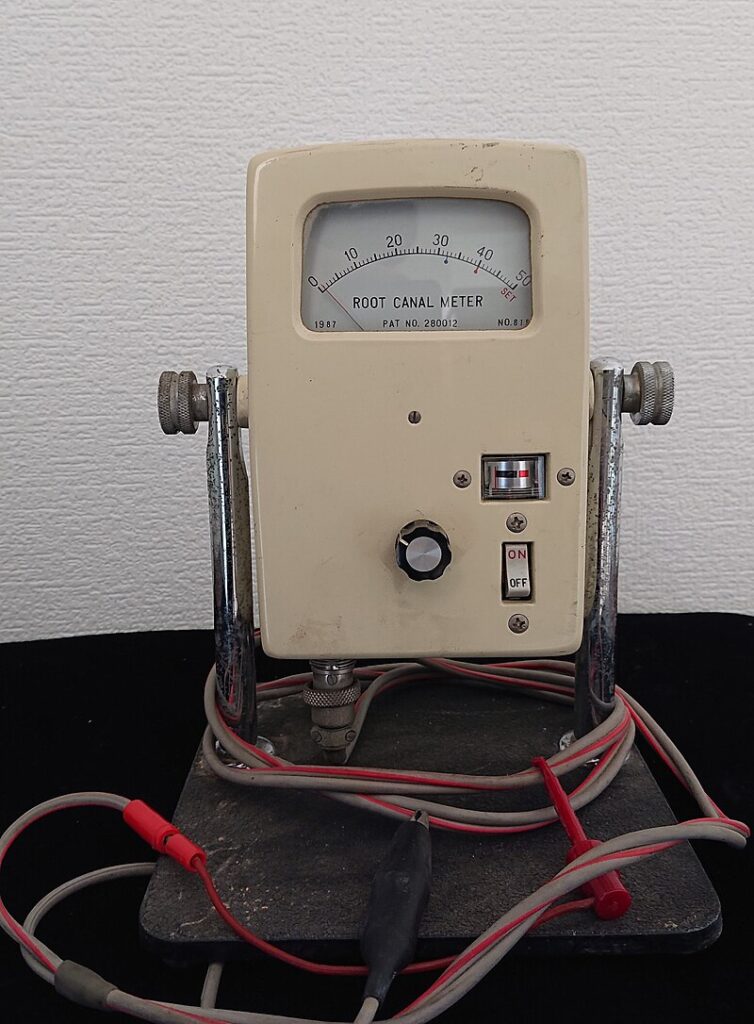
Representative Devices:The original DC ohmmeters used by Suzuki and Sunada, such as the Root Canal Meter.
- Characteristics & Limitations:
- Advantage: Simple principle and easy to operate.
- Fatal Flaw: Requires a completely dry root canal for measurement. Any conductive fluid, such as blood, exudate, or sodium hypochlorite (NaOCl), will cause a premature short circuit, leading to an erroneous reading and a short working length. Due to their poor clinical accuracy, they are now obsolete.
Second-Generation: Impedance-Based Apex Locators
- Core Principle: To address the limitations of DC, second-generation devices switched to using single-frequency Alternating Current (AC). They measure impedance (the opposition to AC flow), not just simple resistance. The theory was that impedance changes as the file moves apically, with a sharp shift occurring at the apical constriction.
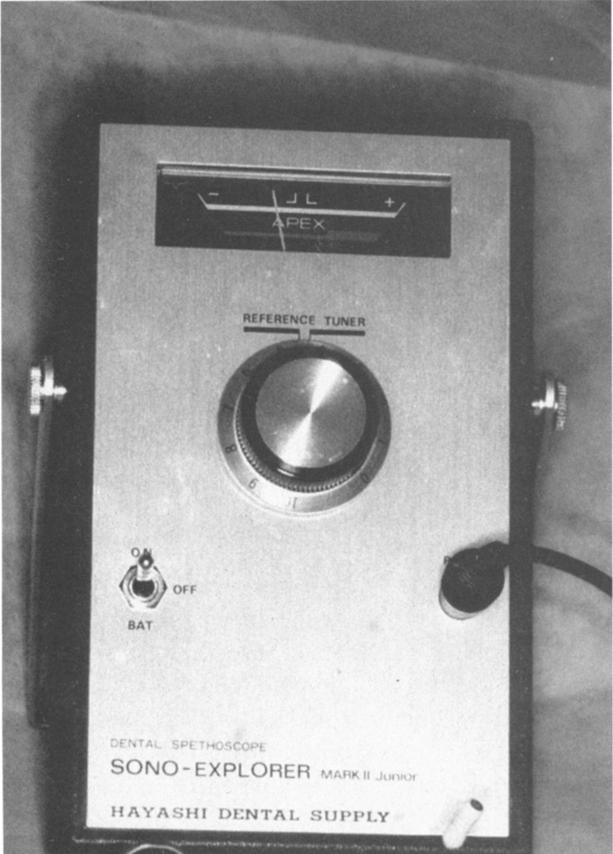
Representative Devices: Sono Explorer
- Characteristics & Limitations:
- Advantage: A theoretical improvement over first-generation devices with slightly better tolerance for moisture.
- Main Drawback: Still highly susceptible to interference from electrolytic fluids. A single frequency was not sufficient to differentiate between the impedance of the canal walls and that of the conductive irrigants, resulting in unstable and often inaccurate readings.
Third-Generation: Dual-Frequency Ratio Method Apex Locators
- Core Principle: This generation represents a revolutionary breakthrough in EAL technology. It operates on the principle that the impedance of biological tissues differs at different AC frequencies. These devices use two separate AC frequencies simultaneously (one high and one low) and calculate the ratio of the two impedance values.
- The Key Insight: This impedance ratio remains relatively constant throughout the main body of the canal but changes dramatically and predictably as the file tip nears the apical constriction. By detecting this sharp change in the ratio, the device can pinpoint the apical terminus with high precision. This Ratio Method effectively cancels out the influence of conductive fluids, as their effect on both impedance values is nullified when the ratio is calculated.
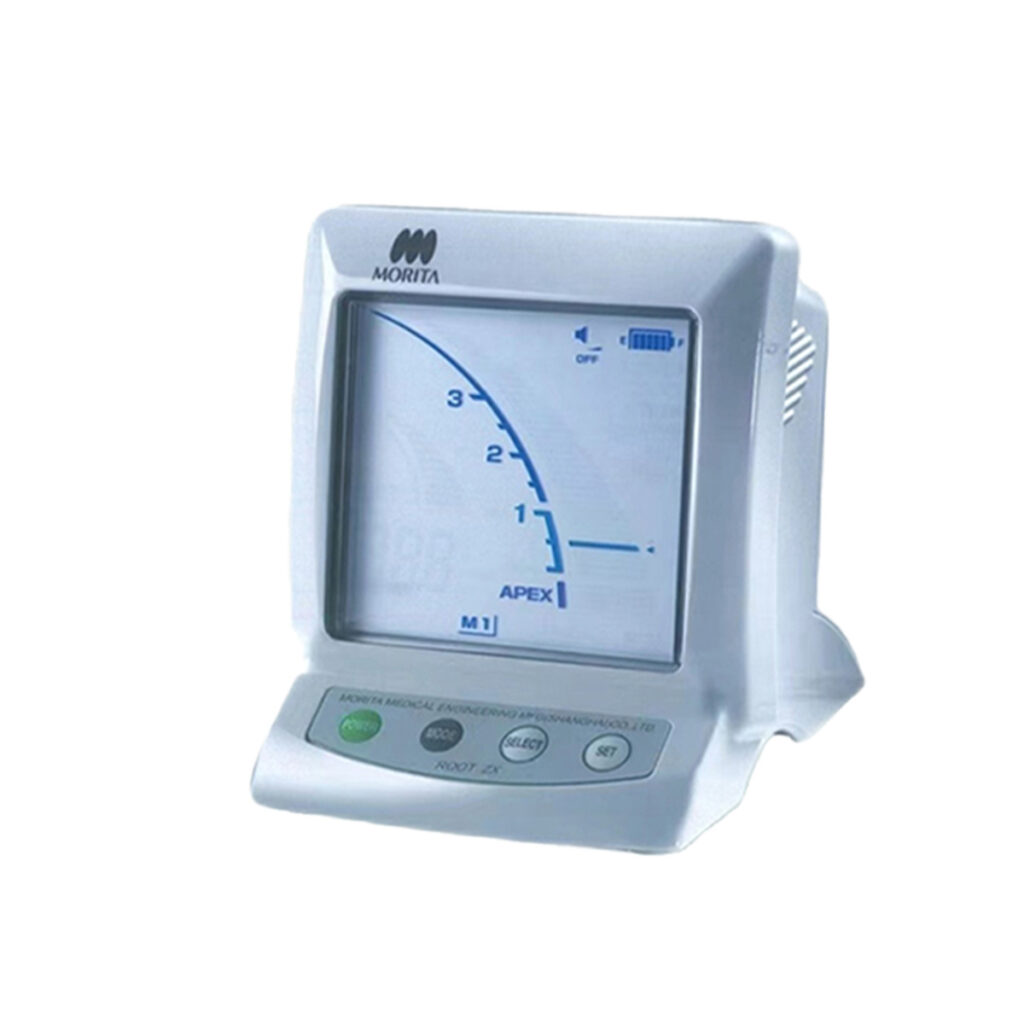 Representative Device: The Root ZX by J. Morita, using frequencies of 0.4kHz and 8kHz, is the classic example of this generation.
- Characteristics & Limitations:
- Major Advantage: Provides highly accurate and repeatable measurements in a wet canal environment containing NaOCl, EDTA, blood, or other fluids. This transformed the apex locator from an unreliable gadget into a dependable clinical tool.
- Limitation: While highly accurate, readings could still drift in certain extreme conditions, such as a very wide open apex.
Fourth-Generation: Multi-Frequency & Algorithm-Based Apex Locators
- Core Principle: Building upon the third-generation’s success, these devices utilize multiple frequencies (e.g., five or more) for measurement. By collecting more data points and processing them with more sophisticated algorithms, they further enhance measurement stability and accuracy in complex canal anatomies.
- Representative Devices: Elements Diagnostic Unit and AFA Apex Finder by SybronEndo.
- Characteristics: These devices feature enhanced signal analysis and often integrate additional functions, such as a Pulp Vitality Test (EPT).
Fifth-Generation: Advanced Signal Processing Apex Locators
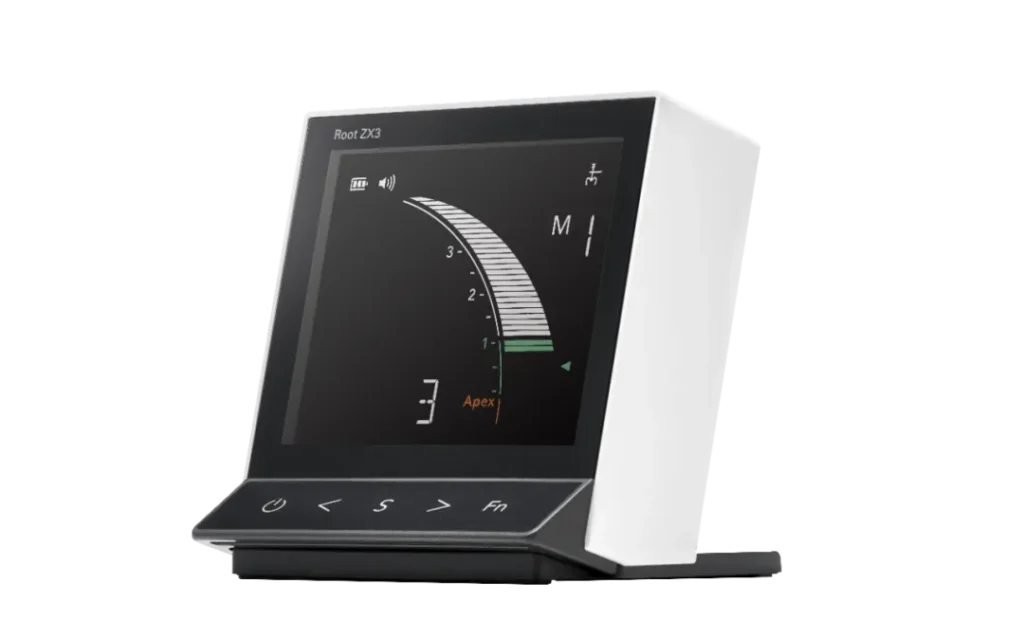
Representative Device: The Root ZX3 by J. Morita
- Core Principle: The defining innovation of this generation lies in the “software” and processing power. While still rooted in the proven frequency-based measurement, these devices incorporate advanced Digital Signal Processing (DSP). Instead of just calculating a ratio, the processor actively analyzes multiple signal properties—such as phase, amplitude, and waveform—to intelligently filter out electrical noise and precisely identify the true apical signal. This “smart” processing allows the device to adapt to challenging intra-canal environments in real time.
-
Representative Device: A prime example of this technological philosophy is the Root ZX3 (by J. Morita). While it utilizes the industry-proven dual frequencies of 0.4kHz and 8kHz, its major advancement lies in its next-generation signal processing capabilities. This allows it to deliver exceptionally stable and responsive readings, even in the presence of blood or residual tissue, embodying the core strengths of a fifth-generation device. The optional High-Frequency (HF) module further extends its capabilities beyond measurement, showcasing its advanced electronic architecture.
- Characteristics: The result is significantly faster response times and superior resistance to interference. These devices provide remarkably stable and “quiet” readings, especially in challenging scenarios such as teeth with apical resorption, perforations, or wide open apices.
Sixth-Generation: Integrated and Intelligent Systems
-
Core Principle: This generation marks a paradigm shift from a standalone measurement tool to a comprehensive treatment system. Its definition is based on functional integration rather than a new measurement principle. It involves embedding a mature and highly accurate apex locator module (typically based on third-generation or later technology) directly into an endodontic motor. The key is the real-time communication between the two components.

Representative Devices: Tri Auto ZX2+
-
Representative Devices: The DentaPort ZX (by J. Morita) is a quintessential example of a sixth-generation system. It integrates the world-renowned Root ZX measurement technology directly with a high-performance endodontic motor. Another highly advanced representative is the TriAuto ZX2+, which takes this integration to the next level by combining both functions into a single, cordless handpiece.
-
Characteristics:
- Real-Time Feedback: The device’s display shows the file’s position relative to the apex in real-time during mechanical instrumentation, providing constant spatial awareness.
- Intelligent Safety Linkage: This is the generation’s hallmark feature. Functions like Auto Apical Reverse/Slow Down can be activated. When the file reaches the predetermined working length, the apex locator module instantly instructs the motor to slow down, stop, or reverse rotation, effectively preventing instrument over-extension. This creates an automated, closed-loop safety system that fundamentally enhances the workflow.
Comparative Overview of EAL Generations
| Generation | Core Principle | Key Characteristic | Main Consideration |
|---|---|---|---|
| First | DC Resistance (6.5 kΩ) | Requires a dry canal | Highly susceptible to conductive fluids |
| Second | Single-Frequency AC Impedance | A theoretical improvement | Unstable readings in electrolytic environments |
| Third | Dual-Frequency Ratio Method | Reliable in wet canal conditions | Performance may vary in extreme anatomical variations |
| Fourth | Multi-Frequency Measurement | Acquires more data for algorithmic stability | An incremental enhancement, not a fundamental shift |
| Fifth | Advanced Signal Processing (DSP) | Intelligent signal filtering & fast response | Performance is dependent on processing power and algorithms |
| Sixth | Integrated Measurement & Motor System | Automated workflow & integrated safety features | Represents a higher-tier equipment investment |
The evolution of the Electronic Apex Locator is not just a story of advancing technology, but of a fundamental shift in product design and user workflow. The initial generations focused on solving a singular measurement challenge. However, with the advent of the robust Ratio Method, the industry reached a level of performance maturity that allowed for diversification.
Today, this evolution has branched into two distinct product philosophies: highly specialized, standalone instruments designed for peak measurement performance, and fully integrated systems that combine measurement and mechanical preparation into a single, cohesive workflow. This progression demonstrates how a single-purpose tool has transformed into a cornerstone of a complete, digitally-enabled equipment ecosystem, offering users unprecedented levels of operational efficiency and system control
If you wish to learn more about specific apex locator brands, popular models, and detailed instructions on their use, please read our The Ultimate Guide to the Apex Locator.


