
In modern endodontics, the precise determination of working length is a critical factor that dictates the success or failure of root canal therapy. The electronic apex locator, often simply called an Apex Locator, has evolved from an auxiliary tool into an indispensable core instrument. However, a crucial question every dental professional asks is: just how accurate are the measurements from an apex locator?
This article aims to provide an objective, evidence-based, in-depth analysis of apex locator accuracy. By combining insights from published scientific literature with core technological principles, we will help you gain a deeper understanding of the true performance of modern devices and master the key factors that influence the stability of their readings. For a broader perspective on how this technology fits into your overall clinical setup, refer to our complete guide to electronic apex locators
Disclaimer: This article is for informational purposes only and is intended for dental professionals. The content herein does not constitute medical advice. Before making any clinical decisions, please refer to the product’s official instruction manual and consult with a qualified medical professional. We only provide technical evaluations and knowledge regarding dental medical devices and are not involved in providing medical services or recommendations.
How Accurate Are Apex Locators? The Science Says Over 90%
A substantial body of scientific literature confirms that modern multi-frequency electronic apex locators demonstrate exceptional accuracy in clinical practice. Their reliability is no longer a question but rather a well-documented fact.
For instance, a systematic review¹ published in the Dental Research Journal, which analyzed multiple studies, reported a significant finding: even in complex cases involving periapical lesions, the accuracy of these devices remains as high as 92%. This powerfully illustrates their stability in real-world, challenging clinical environments.[1]。
Among the many classic devices in this field, the Root ZX series from J. Morita is a frequently studied subject. As early as 1998, a pivotal in-vivo study conducted by Pagavino et al.reported that the Root ZX achieved an accuracy rate of 97% in determining the position of the apical foramen[2]. This early, high-precision data paved the way for subsequent technological iterations and established a foundation for clinical confidence in these devices.
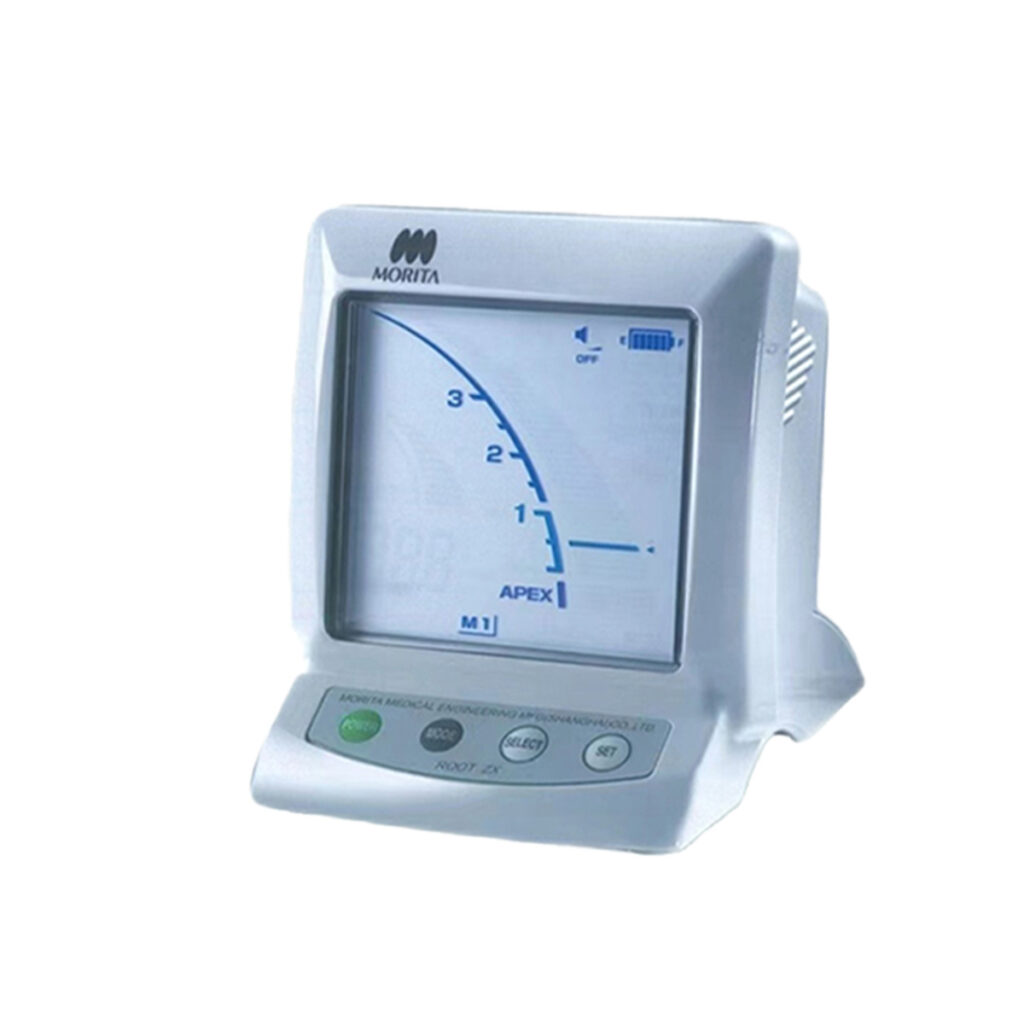
J.Morita Root ZX apex locator
The achievement of such high precision fundamentally stems from technological innovation. Unlike early resistance-based devices, which were highly susceptible to interference from conductive fluids within the root canal, modern multi-frequency apex locators utilize sophisticated algorithms to simultaneously measure impedance values at different frequencies. This technology enables them to intelligently differentiate the apical constriction from other conductive media inside the canal (such as blood or sodium hypochlorite), thereby providing stable and reliable readings under various canal conditions.
What Affects the Accuracy of Your Apex Locator?
Despite the robustness of the technology itself, its accuracy still depends on several variables. Understanding these factors is key to avoiding erroneous readings.
The Condition of the Root Canal: The Role of Electrolytes and Moisture
The principle of impedance measurement fundamentally relies on a stable electrical environment. When the root canal is flooded with conductive fluid (i.e., overly wet), a short circuit may occur, leading to premature readings before the file reaches the apex. Conversely, a completely dry canal lacks the necessary conductivity, which can result in no reading or a delayed reading. The ideal measurement condition is often described as “moist,” not “wet.”
The Presence of Metallic Restorations
Any contact between the endodontic file and a metallic restoration (such as an amalgam filling or a metal-ceramic crown) can create an “alternative electrical pathway.” This effectively bypasses the apical region, causing the device to give an immediate and incorrect “APEX” reading[3]。
File Size and Fit
If the file used within the canal is too loose, it may only make intermittent contact with the canal walls, leading to unstable and fluctuating readings. The selected file should be the largest size that fits snugly against the canal walls and can smoothly reach the working length.
Four Key Factors Influencing the Stability of Apex Locator Readings
The performance of an apex locator depends not only on the technical specifications of the device itself but also on various environmental factors encountered during clinical procedures. Understanding and managing these key factors is instrumental in obtaining more consistent measurement readings under different conditions. The following sections aim to outline four common operational aspects that influence the stability of the device’s readings.
1. Functional Verification Before Use
Before connecting the device to the patient, it is generally recommended to perform a functional self-test. The specific procedure can be found in the respective device’s instruction manual. A common verification method involves bringing the file clip into direct contact with the lip clip and observing whether the screen displays the expected “pathway” or “short-circuit” signal. The purpose of this step is to confirm that the entire measurement circuit—from the main unit to the accessories—is in proper working order, thereby establishing a valid functional baseline for subsequent measurements.
2. Controlling the Conductive Medium within the Root Canal
The fluid within the root canal serves as a necessary conductor for the electrical measurement circuit, but its volume has a direct impact on the stability of the readings. An excessive amount of conductive fluid (such as an irrigant) can create an unintended conductive pathway in the coronal portion of the canal, leading to a premature reading before the file reaches the apex. Therefore, controlling the moisture level within the canal before measurement is a critical step. Generally, using absorbent paper points to remove excess fluid until the canal walls are “moist” but not “wet” is considered one of the ideal conditions for obtaining stable readings.
3. Ensuring Electrical Isolation
The working principle of an apex locator is based on a specific, closed electrical circuit. Any additional conductive contact can form a parallel circuit, which can interfere with the measurement results. Therefore, establishing a “clean” electrical measurement environment is crucial. In clinical practice, the routine use of a dental dam is widely considered one of the most effective means of achieving proper isolation. Its function is to isolate highly conductive fluids like saliva and to help prevent the endodontic file from accidentally touching other conductive bodies, such as the gingiva or metallic restorations, thereby avoiding the impact of potential short circuits on the readings.
4. Confirming the True Apex via Reproducible Readings
When the reading first reaches the apical foramen indicator (e.g., the “0.0” mark), its reproducibility can be verified through repeated measurements. A common operational method is to slightly withdraw the file (for example, by 1-2mm) and then slowly advance it back to the target point. If the device can consistently indicate the same apical position after multiple repetitions of this procedure, the credibility of that reading is generally considered to be higher. This “withdrawal-and-reinsertion” technique provides clinicians with a method to assess the consistency of their measurement results.
Clinical Context and Technological Comparisons
Apex Locators vs. Radiographs: A Performance Comparison
The comparative accuracy of electronic apex locators versus traditional dental radiographs (or dental x-ray) in determining working length has long been a focal point in the field of dentistry. Addressing this topic, a large-scale study published in the journal BMC Oral Health in 2024 provides the latest data for reference. In this systematic review and meta-analysis, Kaur et al. reported that, based on a comprehensive evaluation of existing literature, the performance of electronic apex locators in working length determination was statistically superior to that of intraoral radiographs.
Radiographs provide a two-dimensional image of a three-dimensional structure, which can lead to distortion and misinterpretation. In contrast, an apex locator offers a real-time, dynamic measurement of the physiological apex and avoids radiation exposure. While radiographs remain crucial for overall diagnosis, for the specific task of determining working length, the apex locator provides superior precision[4]。
Laboratory Data vs. Clinical Performance
Choosing an apex locator is much like buying a car and paying attention to its fuel consumption. The “theoretical fuel economy” published by the manufacturer, based on ideal laboratory testing conditions, often looks impressive. However, what we truly care about is the “combined fuel economy” under real-world driving conditions, like our daily commute. Similarly, while an apex locator may demonstrate high accuracy in a laboratory setting, its ability to maintain stability within the complex and variable environment of a live patient’s mouth is the true measure of its reliability[5]. This is why top-tier brands invest significant resources in clinical validation to ensure their devices perform reliably in your actual practice[5].
End of Article
Without a doubt, the electronic apex locator is an exceptionally precise piece of dental equipment that has fundamentally transformed the precision of endodontic therapy. An overwhelming body of evidence supports its efficacy, with accuracy rates consistently reported above 90%.
Of course, to fully unleash the remarkable performance of these devices, merely owning them is not enough. Superior outcomes are born from the perfect synergy between advanced instrumentation and the skilled practitioner.
As a professional dental equipment supplier, Mydentalmall is committed to being your in-depth partner. We don’t just supply reliable, state-of-the-art devices; we focus on ensuring they create long-term value for your practice. To this end, we provide comprehensive operational training and robust after-sales maintenance services, all designed to help you master and utilize your equipment to its fullest potential.


